
With Lord of the Rings you need to understand something: There is no quick version. JRR Tolkien’s work is a saga of epic scale and proportion, making it the original realm of modern geekdom. Nevertheless I’m going to try. In a hole in the ground there lived a hobbit...

Tolkien’s stories are set in a land called Middle Earth that culturally resembles Dark Age Europe (he was Professor of Anglo-Saxon at Oxford), and are actually intended as a kind of pre-history to it. He based a lot of his ideas on the Norse mythic sagas so again we have myth echoing myth. Within the huge and diverse landscape of Middle Earth, a number of tales take place. I’m going to list them in story order rather than publishing order because it makes more sense in the end.
Let's do this...
The Silmarillion – Oh this book alone is a saga. It’s really not a story, it’s a history book and only the hardcore geeks will tackle the Silmarillion, but it's worth the effort if you're into that sort of thing. It begins with the creation of Ea, 'the world that is', then dives off into reams and reams of elf history, the legendary war over the Silmaril jewels that give the book its title, and the rise and downfall of a great nation of men. We understand that over time all the races are falling away from their original potential as the world is blighted by the presence of evil. Finally it covers the timeline leading up to and including the Lord of the Rings, after which the elves leave Middle Earth to the rule of men.

The Lord of the Rings – This pseudo-historical fiction is told over six books split into three volumes. The Fellowship of the Ring sees Bilbo’s ring pass to his nephew Frodo Baggins. It is discovered that this is the One Ring that was made by the evil Sauron to control the other rings of power worn by the leaders of the men, elves and dwarves. Wearing the Ring would enable a strong enough bearer to basically rule the world. Frodo and some friends from his hobbit village leave home to try and find out how to destroy the Ring. On the way they are joined by companions from the other races of Middle earth, forming the Fellowship of the title.
In The Two Towers it’s all gone a bit wrong. The Fellowship is disbanded, two are dead, two captured and being chased by the other three across the country, and Frodo and his loyal gardener Sam are walking into the Dark Lord’s own back yard to try and drop the Ring into the only place hot enough to melt it – a volcano. As evil forces emerge from two fronts (the Towers of the title) some other kingdoms start getting involved when the hobbits prove surprisingly influential, but there’s no longer a ruler able to unite them all against Sauron... is there?
The final title The Return of the King kind of answers this question. The first half of the book is very dark. The last descendant of the old king returns, but ultimately the only hope is for Frodo and Sam to drag themselves to the end of their quest. The others are trying to buy them time, but the Ring is steadily defeating Frodo, and even if he succeeds he may find that the home he left behind has been changed by the war just as much as he has.
 |
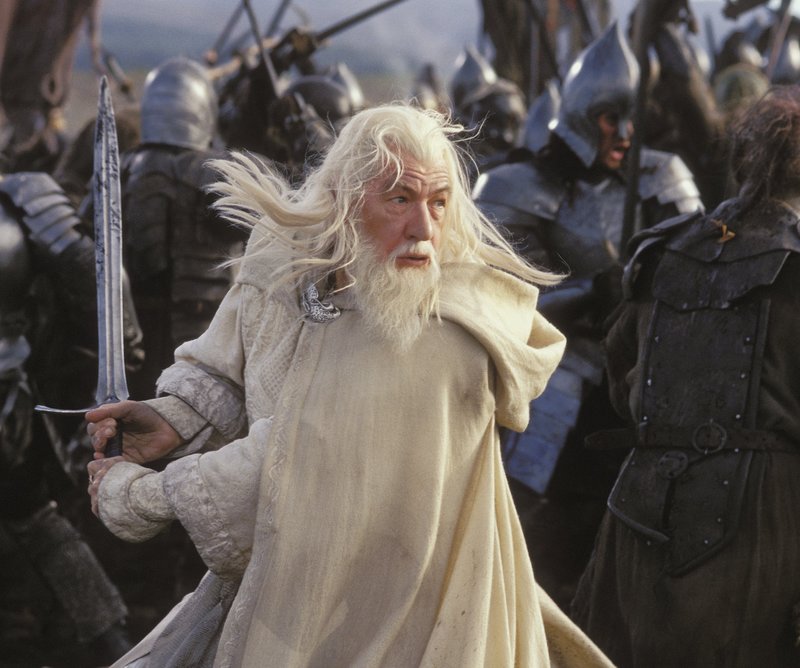
| In high school I did a painting of this scene from the books. What I drew looked almost exactly like this shot from the movie, even though the films wouldn't come out for another five years. |
Drinking game - Peter Jackson live-action versions
There are two other versions of LotR which are animated movies. Don't watch either of them when intoxicated or high as you will think you are on the freakiest trip ever.
 For goodness sakes pace yourself. There's nine hours of movie here. Drink when:
- You see a sweeping landscape.
- Frodo wanders off on his own.
- Someone refers to the Ring as "Precious"
- The Ring is shown in close-up
- Frodo falls down.
- Merry or Pippin do something daft
- Frodo and Sam share 'a moment'
- Gollum coughs
- An elf glows
- Someone says the word "Mordor" and rolls the 'r'
- The fiery Eye of Sauron is seen
- Gimli the dwarf is used as comic relief
A confession
 It ends... just how it should. I don’t want to say too much. If you hadn't already noticed I'm finding almost impossible to be objective here anyway, and with good reason. I love these books. That's the confession I have to make at this point.
 The Lord of the Rings is MY geekdom.
I read them all between the ages of 12 and 17 and I still remember vividly the impression they made on me. I couldn't tell you exactly why, but something just struck true in my psyche and I love these books although I can appreciate they're not everybody's cup of tea. Once every so often I read them through all over again, just because. I have all three Extended edition movies and have watched every single 'Making of' video on them. I own a Lord of the Rings Trivial Pursuit game which no one will play with me because I keep winning. Even now, as a 24 year old, hearing any Hobbit-related news makes me squee like a teenager.
 |
| A friend's elvish role-playing character on the forum. I drew this for them around 2007. |
Tolkien was just the kind of geek we were talking about in the introduction. The world he created for Lord of the Rings to exist in is vast and deep, with multiple species that have their own cultural motifs, its own mythology, detailed histories, maps and genealogies, and carefully constructed languages complete with alphabets and guides to grammar and pronunciation. All of these are included at the back of the final book, just waiting to be picked apart, and for several years this was literally my obsession. Tolkien was one of the first modern authors to expand on his own creation to this extent, which is why we all love him so much and why his books are so popular. You’d better believe I spent days hunched over a notepad teaching myself to write in Elvish. And that I wrote my own stories about hobbits and elves. And drew my favourite scenes over and over. And became part of a web forum linking Tolkien fans from all over the globe in admiration and a bizarre kind of community. I don't have the time to spend on it these days, but although I never met any of these people in person I still counted them as genuine friends.
High fantasy
 |
| Dragons included as standard |
Tolkien’s epic made such an impression that he is rightfully credited with popularising an entire genre – High Fantasy. This is fantasy that is told in a romanticised way, with a high importance on subjects like fate, fulfillment of destiny, virtues, heroism, good vs evil, magic, and a lot of mythical beasties. Other examples of high fantasy include The Chronicles of Narnia by C.S. Lewis, Chronicles of Earthsea by Ursula Le Guin, The Wheel of Time by Robert Jordan, and David Eddings' The Belgariad. Even parodies of high fantasy, like Terry Pratchett's Discworld novels, still fit into the genre.
(The flip-side to this is Low Fantasy, which exists in a similar world and time to ours but with less magic and a much more cynical outlook. Characters are morally grey, the line between right and wrong is often blurred, and the emphasis is on chaos and chance rather than fate. If something supernatural does happen then it's usually on a small scale and is the weird exception rather than the rule. Examples would be The Indian in the Cupboard by Lynne Reid Banks, David Almond's Skellig, Tales of the Otori by Lian Hearn, or The Green Mile by Stephen King.)
The Lord of the Rings affected the genre so much and created so many tropes and cliches that it’s almost impossible to escape from when creating works of fantasy, whether it’s in the form of stories, art or games. Which is fine by me.


No comments:
Post a Comment